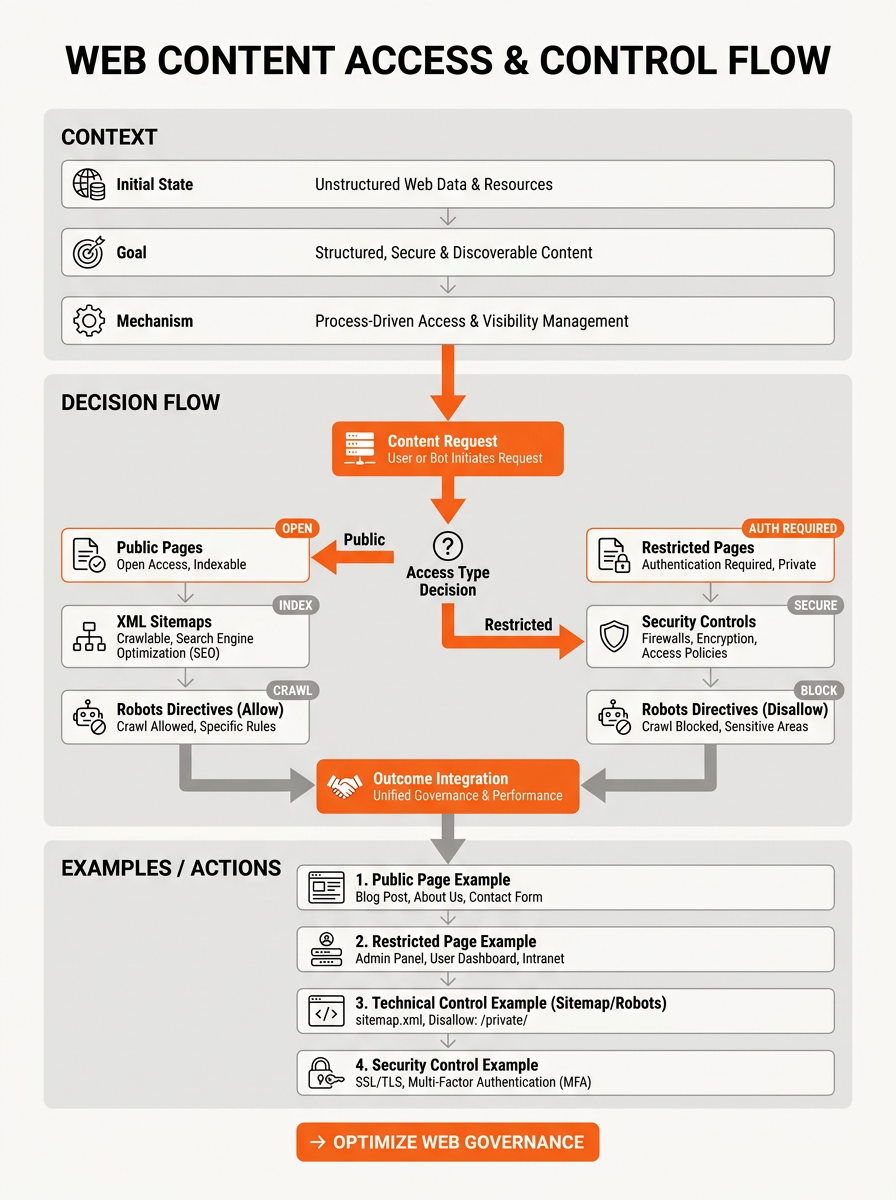
For banks and credit unions, technical website SEO is not a one-time cleanup project. It is operating infrastructure, the same way your core banking platform or compliance workflow is infrastructure. When crawl controls, site architecture, page experience, structured data, and reporting are connected into one accountable system, organic performance becomes measurable and defensible. When they are managed in separate lanes, performance leaks and no one owns the fix. PMA Group's technical SEO services are built around connecting those functions into one accountable system that keeps visibility from decaying.
Technical website SEO for banks and credit unions carries more operational weight than most marketing leaders account for. Search engines and prospective members or customers both evaluate site quality before they engage with a rate, a product, or a branch address. A solid foundation extends the reach of every content and marketing investment. A weak one creates a ceiling that strong content and ad spend cannot break through.
Google's page experience signals, loading speed, interactivity, and visual stability, factor directly into rankings. But in financial services, the consequence runs deeper than a ranking adjustment. Someone comparing mortgage rates or evaluating a credit union is making a trust decision, not a convenience purchase. A page that loads slowly or shifts during interaction doesn't just frustrate them; it undercuts the institution's credibility before a single rate or product detail can make the case. Buyers in financial services leave quietly, and a technically weak page gives them a reason to leave early.
A well-structured technical setup handles indexation control, search visibility, and measurement at the same time. Robots meta tags and crawl directives let teams tell search engines exactly which pages to index and which to ignore, keeping gated portals, duplicate filters, and thin utility pages out of the index. That selective approach produces a cleaner signal for search and more accurate reporting for leadership. PMA Group's financial services SEO work is built around this kind of integrated control rather than page-by-page fixes.
When SEO, web development, compliance, analytics, and content each operate on their own timeline, the same page can get optimized, restricted, and broken within a single quarter. As PMA Group outlines in its AI search readiness guide, institutions that connect these functions under a shared operating model catch problems earlier, move faster on fixes, and produce results that hold. The organizations still managing technical SEO as a series of one-off requests spend more and measure less.
Banks and credit unions improve crawlability and indexation without exposing sensitive content by pairing robots.txt with noindex directives and canonical tags, as well as by securing gated portals with authentication rather than relying on crawl controls alone. Product pages, branch locations, and educational content should be easy for search engines to find and index; gated assets, internal search results, and thin utility pages should stay out entirely.
Getting there requires a coordinated set of controls, not a single setting. Robots.txt manages crawl access, but Google notes it cannot reliably block indexation if a URL is linked from elsewhere. Pairing it with noindex directives and canonical tags is what actually governs what enters the index.
When these controls work together under a documented governance model, compliance and SEO stop competing with each other and start reinforcing the same outcome. That foundation carries directly into how site architecture and page experience either amplify or undercut the visibility gains.
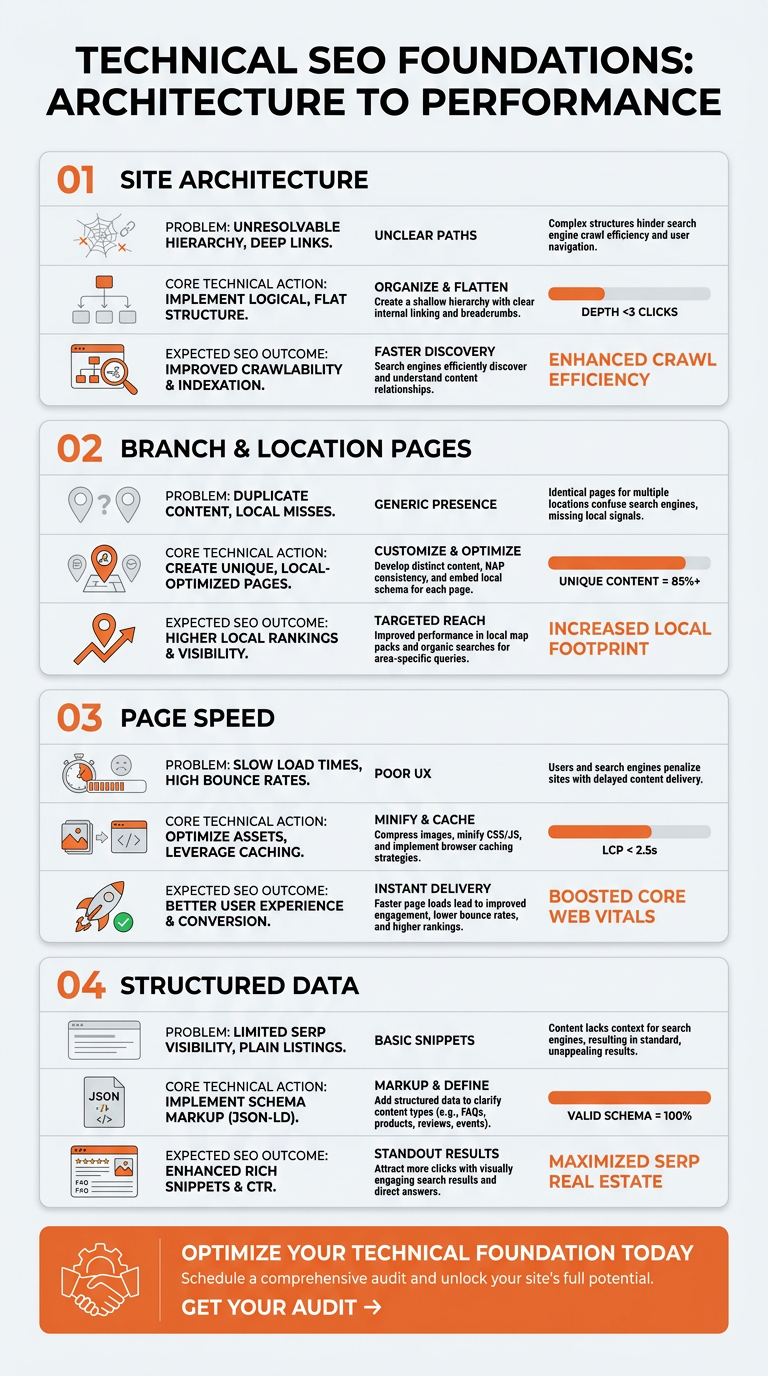
For banks and credit unions, the site architecture that best supports branch SEO and product discoverability moves from product categories to specific account and loan types, then down to individual branch and location pages. This gives search engines a clear path to the full product set while keeping location pages from competing with each other. Site architecture, page experience, and structured data each handle a different part of that discoverability problem, and they reinforce each other when they are built and maintained together. The four areas below show what breaks most often on financial institution websites, what to do about it, and what the SEO outcome looks like when the fix holds.
|
Technical Area |
Common Problem |
Core Action |
Expected SEO Outcome |
|---|---|---|---|
|
Site Architecture |
Product and service pages buried under generic navigation with no clear path from category to specific offering |
Organize pages in a logical hierarchy: product categories → specific accounts, loans, or services → individual branch or location pages |
Cleaner crawl paths and better discoverability for both users and search engines across the full product set |
|
Branch and Location Pages |
Thin, templated branch pages with duplicate content that fail to rank for local searches |
Build dedicated pages with unique location details and apply LocalBusiness structured data including address, hours, geo coordinates, and department properties |
Stronger local search visibility and trust signals that support branch-level discovery in both traditional and AI-generated results |
|
Page Speed and Core Web Vitals |
Template bloat, unmanaged third-party scripts, and unoptimized images pushing metrics outside Google's thresholds (LCP ≤ 2.5s, INP < 200ms, CLS < 0.1) |
Reduce render-blocking scripts, optimize images, tighten mobile layouts, and audit template-level weight across high-traffic page types |
Page experience signals that meet or exceed Google's benchmarks and reduce friction for users on mobile, where most financial searches happen |
|
Structured Data |
Search engines and AI platforms cannot reliably identify the institution's name, services, branches, or FAQs as distinct, trustworthy entities |
Implement Organization markup on core pages and LocalBusiness markup on branch pages; add FAQ and Breadcrumb schema where content supports it |
Richer search appearances, improved entity recognition, and AI visibility signals that connect the institution's digital presence to specific services and locations |
None of these areas functions well as a standalone project. A well-organized architecture makes structured data more accurate because the markup reflects a real content hierarchy. Faster pages reduce crawl waste and improve the experience for users who arrive from organic search. Together, they give both search engines and buyers a clearer picture of what the institution offers and where, which is the operating condition that sustains visibility over time.
Most institutions make real progress on crawl controls, architecture, and structured data and then lose those gains after a CMS update or a site redesign because no one owned the process of maintaining them. The reporting and governance structure that holds technical SEO performance over time requires named owners across marketing, development, analytics, and compliance; a shared backlog; a defined review cadence; and reporting that connects crawl health to business outcomes rather than isolated metrics.
Redesigns, content migrations, new tag additions, and template changes are the most common sources of regression. A page that ranked well before a launch can lose its canonical, gain a noindex directive accidentally, or drop out of the sitemap entirely without anyone flagging it. Google Search Console provides index coverage reports, URL inspection, and issue alerts that catch these problems early, but only if someone is checking them on a defined cadence after every release.
Tracking crawl errors and Core Web Vitals in isolation is not enough for executive reporting. Leadership needs a view that connects those signals to business outcomes: which branch and product pages are indexed and ranking, how organic traffic converts across those templates, and whether page experience improvements are reducing friction on mobile. The Search Console API lets teams pull this data into shared dashboards that tie technical health directly to qualified demand, rather than leaving it buried in a developer tool.
The governance model that holds gains over time is not complicated, but it does require named owners. Marketing, development, analytics, and compliance each affect technical SEO decisions, and when those functions operate without a shared backlog and review cadence, issues accumulate until they erode the financial services SEO gains the institution worked to build. A recurring review rhythm, even monthly, where technical health metrics are reviewed against a prioritized backlog, gives teams a reliable mechanism to catch regressions before they compound.
Marketing leaders at banks and credit unions tend to run into the same technical SEO questions when they start connecting website infrastructure to business performance. The answers below address the implementation and governance questions that come up most often in that process.
HTTPS is a direct page experience signal that Google uses in ranking. For financial institutions, secure delivery is both a compliance baseline and a search requirement. When compliance teams add security headers or authentication layers, they should document which URLs are affected so robots directives and canonical tags stay accurate and consistent.
The highest-impact changes are usually operational: reducing JavaScript execution time, setting explicit image dimensions to prevent layout shift, and using resource hints like fetchpriority to load key content faster. According to Google's Core Web Vitals guidance, improving Interaction to Next Paint (INP) often means breaking up long tasks that block the browser. For bank and credit union sites, bloated third-party scripts from chat tools, rate widgets, and tag managers are common culprits.
Schema.org's BankOrCreditUnion type provides the markup vocabulary to describe your institution, its branches, hours, fees, and location details in machine-readable form. When that markup reflects your actual site structure, search engines and AI platforms can surface the right information more reliably. Structured data works best as part of a maintained template, not a one-time addition that goes stale after a site update.
Branch pages usually underperform because they are built from identical templates with minimal variation in content, schema, or internal linking. Search engines treat them as thin duplicates rather than distinct, relevant pages. Each branch page should reflect real location details, services offered at that branch, and local context that makes the page genuinely useful to someone searching in that area.
Useful reporting connects crawl health to business visibility rather than tracking raw keyword counts. Track indexed page quality, Core Web Vitals trends by template, organic traffic to product and branch pages, and conversion paths from organic entry points. When leadership can see how technical health connects to qualified traffic and pipeline, SEO stops looking like a maintenance cost and starts reading as a measurable growth input.
Technical SEO holds its value when it is part of a connected system, not a one-time audit. Crawl controls, site architecture, Core Web Vitals, structured data, and crawl budget management each do important work on their own, but they compound when governed together. For banks and credit unions, that means aligning web development, compliance, analytics, and marketing around a shared roadmap with clear owners and a regular review cadence.
The right starting point is an audit that surfaces your highest-impact gaps across those areas and organizes them into a prioritized plan. That is what separates institutions that hold organic performance from those that rebuild it after every redesign. PMA Group can audit your technical SEO and AI visibility gaps and build a more accountable search system, one that treats your website as growth infrastructure, not a maintenance task.