For insurance agencies and brokers, technical website SEO is the operating foundation that decides whether your services get found, whether visitors trust what they see, and whether that traffic turns into quote requests without depending on paid media. The sections ahead cover which fixes move the needle first: getting the right pages indexed, structuring service and location content so both search engines and buyers can follow it, improving speed where abandonment actually happens, and using structured data, security signals, and mobile usability to reinforce credibility at every step. PMA Group works with agencies to turn those technical gaps into a connected visibility system, not a one-time cleanup project.
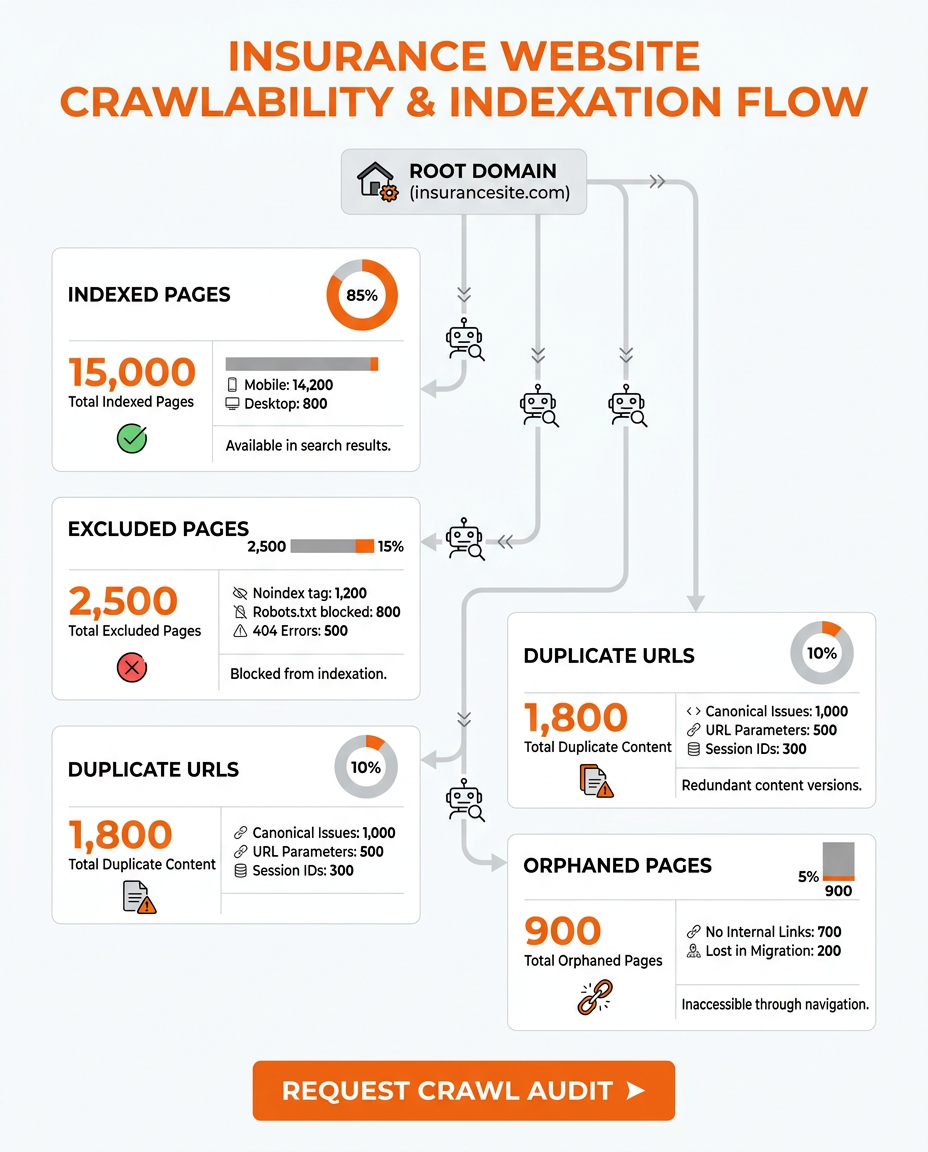
Before investing more in content, backlinks, or paid search, insurance agencies and brokers need to confirm that search engines can actually reach and index the pages that drive quote requests and consultations. Crawlability and indexation issues are one of the most common reasons a technically capable site underperforms in search results. Fixing them first makes every other investment work harder.
Search engines allocate a limited amount of crawl activity to each site, so pages that are hard to reach simply don't get indexed. According to Google's crawl budget guidance, duplicate URLs, parameter-driven pages, and redirect chains consume that budget without contributing to visibility. When your highest-value service or quote-intent pages are competing with low-value URLs for crawl attention, they lose ground even when the content itself is strong.
Thin navigation, inconsistent internal linking, and duplicate URL structures are common across insurance websites, often because site builds prioritize design over architecture. The result is orphaned pages with no internal links pointing to them, near-duplicate carrier or coverage pages that confuse search engines about which version to rank, and quote-flow pages accidentally excluded by robots directives. Google Search Console's page indexing report surfaces these exclusions by category, making it a practical starting point for any audit.
A useful crawlability audit is not a broad site sweep. It focuses specifically on which service pages, location pages, and quote-entry paths are excluded, duplicated, or flagged in the Coverage report with the wrong canonical signals. That scoped approach tells you what is actually suppressing qualified demand, not just what is technically imperfect. PMA Group's SEO and AI visibility work treats crawl and indexation health as a prerequisite before any content or link-building investment is made.
Most insurance agency websites reflect how the agency organizes itself internally with products, territories, and carrier relationships layered onto the same pages. Search engines don't share that organizational logic. When a single page tries to cover commercial auto, three service territories, and two carrier partners at once, it gives search engines no clear topic signal and gives buyers no clear answer to what they searched. A page built to mean everything ranks for nothing and converts at a fraction of what a focused page would.
The fix is giving each page type a distinct job. Here is what that looks like in practice:
The goal of this kind of structure is not to produce more pages for the sake of volume. It is to make sure that when a buyer searches for a specific coverage type in a specific market, your site has a page built to answer that question clearly, and that technical SEO and site architecture decisions reinforce that clarity all the way down to how search engines crawl and index the result.
Site speed and Core Web Vitals directly affect whether high-intent visitors stay long enough to request a quote or leave before your agency ever gets a chance. For insurance websites, a slow page on a high-intent path loses the lead before SEO gets credit for the loss.
The pages that matter most are quote-request paths, high-intent service pages, and mobile entry points. A delay on a general blog post is low risk. A delay on a commercial auto quote form is a lost opportunity. Buyers in insurance categories are comparing providers quickly, and friction before trust is established sends them elsewhere. PMA's insurance marketing guide makes this prioritization explicit: fix the conversion path first, then work outward.
The most common culprits are heavy third-party scripts, oversized images, unstable page layouts, and slow server response times. These slow down rendering, shift content unexpectedly, and make forms harder to use on mobile. PMA's technical SEO and web maintenance work identifies these same issues as the top sources of friction on high-intent pages and notes that JavaScript rendering problems in particular can suppress both crawlability and perceived speed at the same time.
Core Web Vitals are useful because they measure what users actually experience: load speed, visual stability, and responsiveness. Treating them as a scorecard to optimize for its own sake misses the point. As PMA's 2026 organic traffic guide frames it, these signals are diagnostic tools that reveal where technical friction is suppressing both rankings and conversion efficiency. When you fix what they surface, buyers get a smoother path to contact and search engines will reward the improvement.
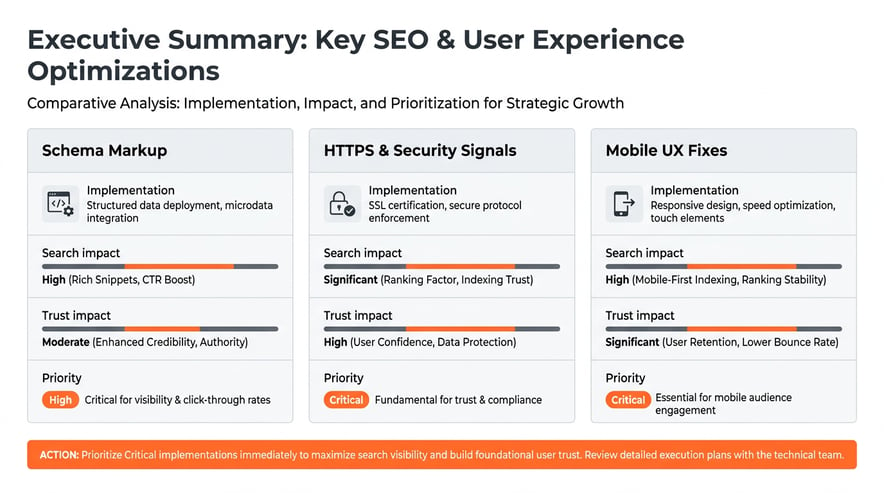
For insurance brokers, schema markup and structured data directly improve how Google and AI-driven search results interpret your agency's identity, services, and locations. That interpretation shapes whether you appear at all in the answers buyers are getting from AI tools and featured results. The technical choices around structured data, site security, and mobile form usability aren't separate concerns; they work together to tell both search engines and prospective clients that your site is credible enough to trust with sensitive information.
The three areas below are worth treating as a connected layer of trust infrastructure rather than isolated fixes.
|
Technical Area |
What to Implement |
SEO Effect |
Buyer-Trust Effect |
Priority |
|---|---|---|---|---|
|
Schema Markup |
InsuranceAgency JSON-LD on the homepage and key service pages; LocalBusiness structured data on location pages (including geo, hours, legalName); FAQPage schema on high-intent question pages |
Helps search engines and AI discovery systems assign clear meaning to agency identity, coverage types, and locations; reduces ambiguity in AI-generated answers |
Shows buyers explicit, machine-readable proof of who you are and what you cover before they click |
High |
|
HTTPS and Security Hygiene |
Valid SSL certificate across all pages and subdomains; eliminate mixed-content warnings; ensure quote forms and contact pages carry visible security indicators |
HTTPS is a ranking signal and a prerequisite for modern browser features; missing HTTPS suppresses indexation and can trigger browser warnings that block traffic |
Buyers evaluating insurance providers make a fast risk judgment before submitting personal data; a security warning on a quote form ends the session |
High |
|
Mobile UX |
Mobile-first layout on quote-request and contact pages; touch-friendly form fields; no intrusive interstitials; stable layout with no content shift on load |
Google indexes the mobile version of your site first; mobile UX issues flagged in Core Web Vitals directly affect how pages rank on high-intent queries |
Buyers comparing providers on a phone expect forms that work cleanly; friction before the first field is filled is enough to lose the inquiry |
High |
When these three areas work together, the result is a site that search engines can read clearly, AI systems can interpret reliably, and buyers can trust enough to act. PMA's guidance on AI visibility optimization is consistent on this point: structured data removes ambiguity for machines the same way security signals remove doubt for people, and both matter more in categories where personal information is on the line.
Before committing budget to technical website SEO, most insurance agency leaders want straight answers, not a project pitch. The questions below address the decisions that actually move the needle: where to look first, how to prioritize competing fixes, and what the real-world payoff looks like for visibility and qualified demand.
Start by checking whether your key service and quote pages are actually indexed. If Google cannot reliably reach those pages, better content will not help. A technical SEO audit surfaces crawl errors, duplicate URLs, and missing canonical signals before you invest in content improvements.
Crawlability and indexation come before everything else. Once search engines can reliably reach your pages, fix site structure so each page has a clear, distinct job. After that, address Core Web Vitals on the paths where buyers are most likely to abandon, particularly quote-request and contact forms.
These three signals tell search engines and AI platforms what your agency does, where you operate, and whether your site is safe to trust. Structured data helps AI-driven discovery interpret your services and locations more accurately. Insurance agencies investing in these areas see stronger presence across both traditional results and AI-generated answers.
Yes, but only when technical fixes are connected to a broader visibility strategy. When crawlability, structured data, speed, and site architecture all work together, organic pages earn more consistent placement without ongoing ad spend. PMA Group's SEO and AI Visibility Optimization practice is built around exactly that outcome.
Monthly monitoring is the practical standard for insurance agencies that want to hold their visibility gains. Site updates, new pages, platform changes, and algorithm shifts can reintroduce crawl issues or break structured data. Catching these regressions early keeps them from affecting rankings or lead volume before you even notice.
Agencies that fix the technicaI foundation first get more return from every investment that follows. Content, outreach, and paid campaigns all perform better when search engines can reach the right pages, interpret them accurately, and trust the site enough to surface it. Crawlability, structured data, speed, page architecture, and AI visibility aren't parallel workstreams; they're the conditions that determine whether the rest of the marketing system works. Skip the foundation, and additional spend compensates for structural drag instead of compounding on a working base.
Before increasing paid spend or publishing more content, review which technical gaps are quietly blocking discoverability and qualified demand. Agencies that close those gaps first get more from every dollar they spend afterward.
PMA Group's SEO and AI visibility work starts with a diagnostic across those specific gaps, crawlability, structure, speed, and structured data, so you know what to fix first and what each fix will return as part of a broader organic business growth strategy.