Technical website SEO for law firms is not a back-end maintenance task. It is the operating infrastructure that determines whether search engines trust the site, whether a prospect reaches the right practice page, and whether that visit becomes an inquiry... or goes to a competitor whose site is simply easier to read and navigate. This guide covers five technical foundations that determine law firm search visibility: crawlability, site architecture, mobile performance, schema markup, and measurement. PMA Group connects each to intake outcomes and CRM reporting, so firms can see which pages generate qualified demand and which consume crawl budget without returning anything.
A law firm's search visibility depends on whether search engines can reliably access and understand its pages. Crawlability and indexation are the foundation of that access. Without them, even well-written practice pages and attorney bios will not surface when a prospective client is actively searching for legal help.
Search engines index what they can reach. If a practice area page or attorney bio has a crawl error, a conflicting robots directive, or a broken internal link pointing to it, that page effectively does not exist in search. Firms regularly invest in content and see little return because the underlying access problems have not been addressed. No amount of good writing overcomes a page search engines cannot read.
Outdated blog posts, near-duplicate location pages, parameterized URLs from site filters, and pages left over from old site migrations all consume crawl attention that should go to high-intent pages. PMA's technical SEO and web maintenance work identifies exactly this pattern: indexation waste dilutes the signals search engines use to evaluate a site's authority and relevance. The result is that the pages most likely to generate qualified inquiries compete with low-value pages for the same limited crawl budget.
The practical fix starts with a structured audit that sorts every page into one of four categories: index it, consolidate it with a related page, redirect it, or block it. As PMA outlines in its guidance on AI and search visibility optimization, prioritizing revenue-generating pages, such as practice area hubs and location pages, and resolving crawl issues there first produces the fastest visibility gains. The goaI is to make sure search engines spend their time on the pages most likely to bring in the right clients.
Most law firm websites are organized around how the firm sees itself, not around how a prospective client thinks about their problem. That disconnect costs firms real search visibility and qualified inquiries.
A well-structured site keeps pages no more than three clicks from the homepage, connects broad practice categories to specific service and attorney pages, and gives both users and search engines a predictable path to follow.
Getting architecture right is one of the faster wins in technical SEO because it improves crawl efficiency and user pathing at the same time. The next factor that affects both is how quickly and reliably those pages load.
How page speed and mobile performance influence law firm SEO and intake conversion comes down to one pattern that costs firms qualified demand: slow pages rank lower and lose the prospect at the exact moment they are ready to act. Most people searching for legal help are on a phone, often mid-decision, and they will not wait through a slow load or a broken form to reach a firm.
Abandonment is the real cost of a slow law firm website. Mobile visitors searching for an attorney are often in the middle of a decision, and a page that loads slowly or breaks on a small screen sends them to a competitor. The visibility problem and the conversion problem are the same problem.
Core Web Vitals, image compression, and script control are where most performance gains come from. Heavy scripts, unoptimized images, and bloated themes create friction that compounds across every step: discovery, trust, and the decision to contact the firm. PMA's law firm SEO framework treats these as continuous governance, not one-time fixes.
Speed improvements only create value when they extend through the full intake experience. Phone taps should work on the first try. Contact forms should load fast and submit cleanly. Attorney bio pages and practice area content should be readable without zooming or scrolling past broken layouts. That end-to-end path is what turns a well-ranked page into an actual inquiry.
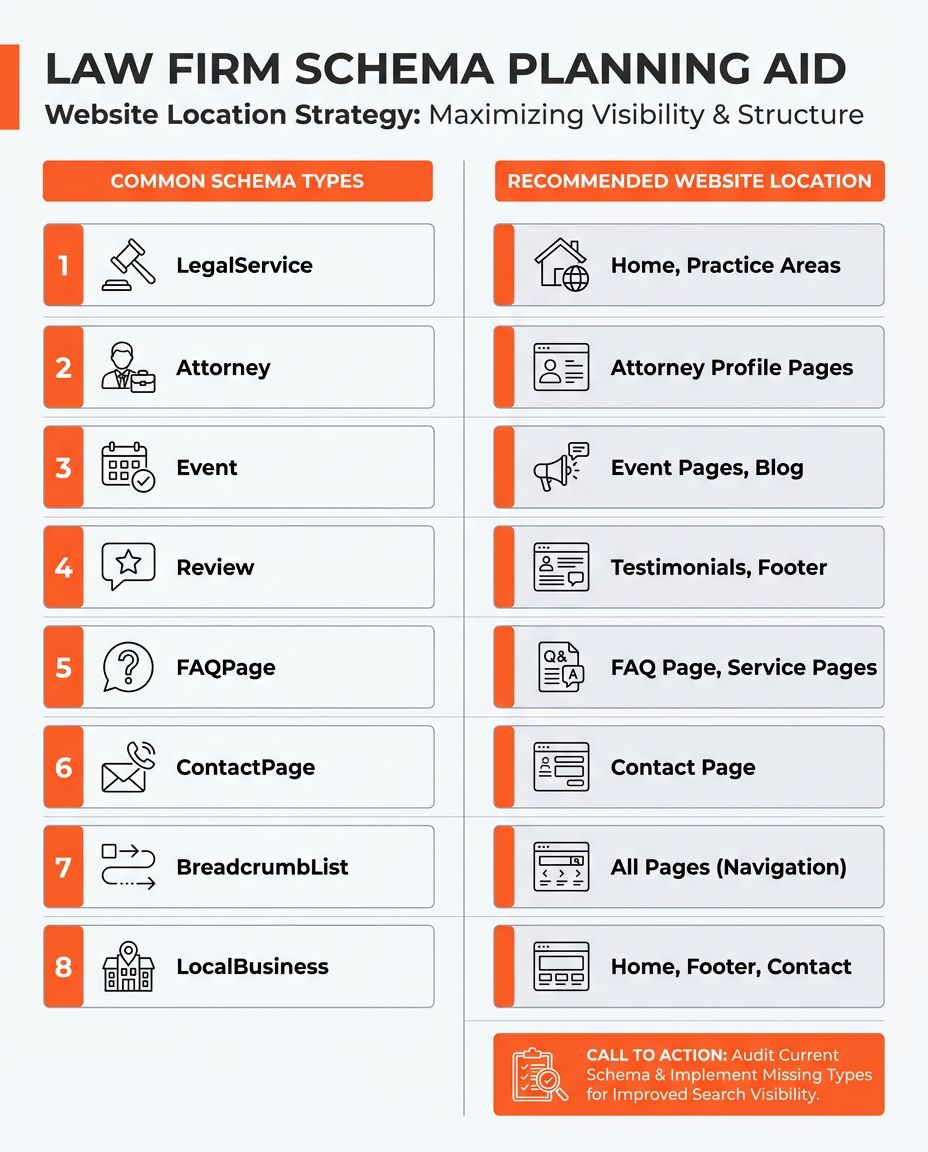
Search engines can read your website, but schema markup tells them what to make of it. For law firms, that distinction matters because a practice page, an attorney bio, and an office location all carry different signals, and without structured data in place, search engines are left to guess at the relationships between them. The result is weaker local visibility, less consistent trust signals, and a site that competes at a disadvantage against firms whose technical setup makes those connections explicit.
The most effective approach maps schema to pages by intent, using Schema.org's LegalService type and its related types as the foundation, then layering in Google's recommended properties for each page category. The table below shows which schema types belong where and what each one communicates to search engines.
|
Page Type |
Schema Type |
What It Signals |
Key Properties to Include |
|---|---|---|---|
|
Homepage / About |
|
Firm identity, brand authority, contact details |
|
|
Practice area pages |
|
Service scope and relevance to legal queries |
|
|
Attorney bio pages |
|
Individual authority, credentials, and role at firm |
|
|
Office / Location pages |
|
Physical presence and local search relevance |
|
|
Testimonials / Review sections |
|
Peer validation and client trust signals |
|
|
FAQ sections on service pages |
|
Answer-ready content for featured results and AI surfaces |
|
Google's LocalBusiness structured data guidance is specific about what each location page needs: address, geographic coordinates, phone number, and business hours at minimum, with the correct subtype applied rather than a generic label. Firms with multiple offices often skip this level of detail, which weakens local pack performance in exactly the markets where they are trying to grow.
Schema markup only works as a trust signal when it is accurate, complete, and consistent with what appears on the page. As PMA's work on AI visibility optimization makes clear, incomplete or conflicting structured data creates noise that makes it harder for search engines and AI platforms to surface the right firm in the right context.
Law firm leaders often understand that technical SEO matters but aren't sure which issues to prioritize or how to tell if fixes are actually working. The questions below address the decisions that show up most often when firms start auditing their sites and connecting technical performance to real business outcomes.
Duplicate content splits search engine attention across multiple URLs instead of concentrating it on one strong page. Google's canonicalization guidance treats rel="canonical" as a hint, not a command, so relying on it without cleaning up the underlying problem leaves ranking signals scattered. Thin pages, like placeholder attorney bios or boilerplate practice descriptions, drain crawl budget without supporting qualified demand.
Start with Google Search Console for impressions, clicks, and indexation errors, then layer in Core Web Vitals scores, crawl coverage, and organic-to-intake conversion rates. The MSBA recommends tracking call tracking and rank movement alongside traffic data to connect search performance to actual client inquiries. Rankings alone don't tell you whether the right prospects are finding the right pages.
Consolidate when two pages target the same intent and neither ranks well on its own. Redirect outdated URLs to the closest relevant page rather than letting them return errors or thin content. Use Google's consolidation guidance as the framework: separate pages earn their place only when they serve genuinely distinct search intent, such as different practice areas, office locations, or attorney profiles with real depth.
Search engines and AI platforms both rely on clean, crawlable, well-structured sites to surface relevant answers. As traditional organic traffic declines by 15–25% for some queries due to AI-generated results, the firms that maintain strong technical foundations are better positioned to appear in those AI-driven answers. Technical SEO and AI visibility are now part of the same infrastructure decision. A free SEO audit can surface where the gaps are across both.
Technical fixes only matter when you can trace them to results. Resolving crawl errors, improving page speed, and implementing schema are the right moves but without a reporting layer that connects those changes to intake data, you have no way to confirm they improved the pages that drive qualified demand. Google Search Console surfaces impression data, indexation status, and Core Web Vitals scores at the page level. Connect it to Google Analytics and you can see not just traffic volume, but whether the right prospects are reaching the right pages and taking action.
The right priority is not fixing every technical issue at once. It is identifying which problems are blocking high-intent pages from ranking and converting, then working through them in an order that reduces waste and improves the intake path. PMA Group's Organic Business Growth Strategies are built around exactly that sequence: surface the gaps, fix what matters most, and connect the results to CRM and reporting so growth stays measurable. That is how technical SEO for law firms stops being a maintenance task and becomes the infrastructure that turns search visibility into qualified demand. Request a free SEO audit to see where your firm's technical foundation stands.
Book your complimentary SEO and & AI audit today.