
Hyper local SEO for law firms is not about chasing map pack positions in isolation. It works when Google Business Profile, location-specific pages, authority signals, and market-level reporting are built to support each other as one connected system. PMA Group helps law firms build that system, so local search produces retained matters, not just traffic.
Appearing in the local three-pack feels like a win, and in some markets it still is. But for law firms competing on high-value and competitive practice areas a map pack position is the start of the conversion problem, not the end of it. Google's local ranking system weighs relevance, distance, and prominence, none of which account for whether a searcher lands on a page built for their specific need, market, or intake path. Hyper local SEO for law firms closes that gap by connecting visibility to what actually follows the click.
If the click lands on a generic homepage instead of a page built for that city, practice area, and client situation, the searcher leaves. Local ranking factors like profile signals and citations earn the impression. Location-specific pages, trust signals, and a clear intake path earn the client. Both jobs need to work together or the ranking produces traffic without revenue.
The map pack is no longer the only local result that matters. Local AI answers now pull from Google Business Profile data, website content, and entity signals simultaneously. A firm that optimizes only its profile, without aligned web content and authority signals, becomes invisible in those results. As an example, the PMA's personal injury SEO guide explains how this should operate as one integrated system, not separate profile and page projects.
Firms that grow efficiently are able to stop thinking in terms of overall organic traffic and start measuring output by market. Which cities generate qualified consultations? Which practice-location combinations produce retained matters? That shift requires local market SEO assets built and tracked by geography, not rolled up into one site-level report. When each target market has its own profile, page, and attribution path, the firm can see where to invest more and where visibility is not translating into business.
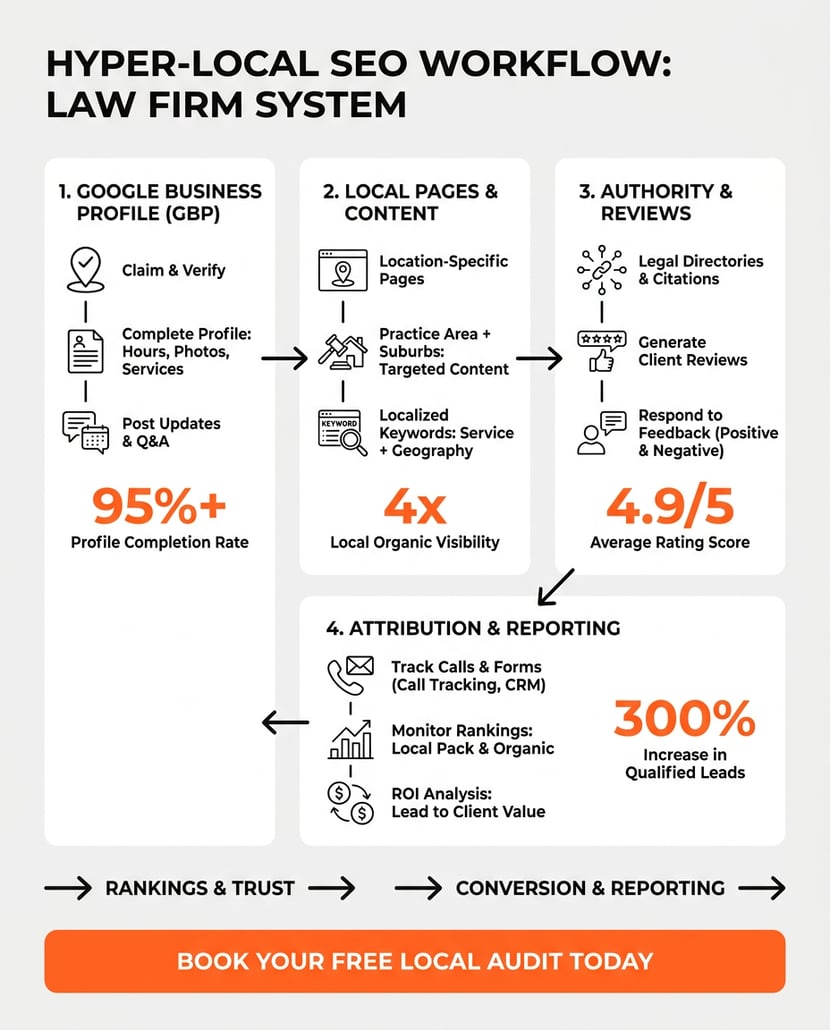
For law firms in competitive local markets, the highest-value Google Business Profile optimizations are primary category accuracy, consistent NAP data, location-matched destination links, and an active review workflow. None of these tactics require creative work, just operational discipline. When several firms appear in the same map pack, those signals are what determines which one earns the click.
Getting the basics right matters more than most firms expect:
Profile visibility only converts when the click goes somewhere useful. That connection between the profile and the landing page is where most firms lose ground, and it is where the next piece of the local system begins.
Building location-specific landing pages that rank and convert requires more than copying a template and swapping city names. Each page needs to connect a real market, a specific office or service area, and the legal needs that bring people there. When those elements align, the page works for both search engines and the prospective client deciding whether to call.
A location page that only changes the city name tells Google and your prospective client very little. The pages that perform connect one market to actual proof: which attorneys serve that area, what cases they handle there, and what a client in that city or county should know before reaching out. That specificity separates a page that ranks from one that sits idle. Each location asset has one job, and needs to do it well.
Nearby service area and city pages support hyper local SEO only when each one has a clear, differentiated reason to exist. Thin content, such as pages with near-identical copy, no unique proof, and no local signals, will bloat a site and weaken the stronger pages around it. A page earns its place when it reflects genuine relevance: local court systems, common case types in that market, or attorneys with real ties to that community. One focused page outperforms five generic ones.
Rankings bring traffic. Conversion depends on what happens when someone lands. Strong location pages answer local intent fast, show trust signals above the fold, and reduce friction with clear phone numbers, intake forms, and an attorney profile tied to that market. PMA's law firm AI visibility guidance frames conversion-focused structure as something built into the page from the start, not added as an afterthought once rankings arrive.
Most law firms invest real effort in directory listings and studies such as BrightLocal's research shows that citation volume carries relatively low weight in local rankings compared to reviews, behavioral data, and on-page relevance. The effort is not wasted, but it is not differentiating either. Stronger local authority comes from a consistent firm entity across the web, links from sources that make sense for your market and practice area, and off-site mentions that reinforce the same positioning your website and Google Business Profile already communicate. Local link-building tactics like sponsorships, local media placements, bar association involvement, and community events tend to produce the kind of credible, verifiable signals that hold up over time.
Reviews deserve the same operational discipline as any other intake workflow. A firm that asks for reviews only occasionally will fall behind competitors who treat it as a consistent process tied to matter closings. Steady review generation, prompt responses, and acquiring reviews that name the specific office or city all reinforce local relevance while building the client trust that drives consultations. As PMA Group's local market SEO guidance makes clear, law firms in trust-based industries gain more from authority signals they can sustain and verify than from chasing every directory listing that promises a shortcut.
Law firms should track local SEO performance by market, not by site. Assigning distinct UTM-tagged profile links, call-tracking numbers, and CRM intake fields to each city or office will help isolate which markets are producing. Unfortunately, most law firms currently measure in aggregate: total organic sessions, overall ranking positions, combined form submissions. That view makes it nearly impossible to identify which city page, which office profile, or which service area is actually converting.
|
Tracking Layer |
What to Measure |
Tool or Method |
Business Signal |
|---|---|---|---|
|
Google Business Profile |
Calls, direction requests, website clicks by location |
GBP Insights, UTM-tagged profile links |
Which offices drive local search engagement |
|
Location pages |
Organic sessions, scroll depth, CTA clicks by page |
Google Analytics 4, Search Console |
Which city or service area pages attract and hold intent |
|
Call tracking |
Call volume, duration, and source by market |
Dynamic number insertion (DNI) tool |
Whether local search calls convert to consultations |
|
Form attribution |
Form submissions tied to originating page and channel |
CRM intake fields, hidden source fields |
Which local pages generate qualified contact requests |
|
CRM and intake disposition |
Lead-to-consultation rate by market or office |
HubSpot or practice management system |
Which markets produce retained matters, not just inquiries |
Connecting these layers does not require a complex analytics build. It requires consistent UTM parameters on profile links, a DNI setup that maps numbers to specific locations, and CRM fields that record how a prospective client first reached the firm. Once those inputs feed one reporting view, the firm can see where local SEO is converting and where a strong ranking is generating clicks without generating revenue. That distinction is where smarter budget and operational decisions get made.
The questions law firm leaders ask most about local SEO tend to come from real operational friction: too many pages, a profile that ranks but does not convert, and no clear read on when the work starts paying off.
There is no magic number. The right threshold is whether each page earns its place with distinct, relevant content tied to a real market the firm serves. Google's own guidance flags duplicate and thin content as a quality risk. Build pages where you have genuine local relevance, real attorney presence or service delivery, and enough differentiated content to serve a prospect in that market.
Start with what happens after the click, not before it. A weak consultation rate usually points to a disconnect between the profile and the landing page it sends traffic to. Check that the destination page matches the searcher's market, practice need, and intake path.
Expect meaningful signal in three to six months for most competitive legal markets. Technical improvements and profile updates can show movement faster. Substantive visibility, the kind that drives qualified consultations consistently, takes longer to build. PMA's law firm SEO guide outlines realistic timelines tied to authority-building, not just ranking position. Patience matters less than having the right tracking in place so you can read the signal when it arrives.
Most competitive local markets are not won by the firm with the strongest map pack position. They are won by the firm that can clearly see which markets generate qualified case leads and keep investing there while also pulling back where rankings produce nothing but clicks. That capability only exists when Google Business Profile, location pages, authority signals, and intake attribution are built as one connected system, each reinforcing the others and feeding a reporting view that shows performance by market, not just traffic by channel.
The next practical step is an honest audit of which local assets are working and which are disconnected. Check whether your profiles comply with Google's GBP guidelines, whether your location pages match real search intent and practice need, and whether your GA4 attribution setup can actually trace a local search visit to a retained matter. When those inputs connect, you stop guessing which markets deserve more investment.
PMA Group audits law firms' local search presence, closes the gaps between profile visibility and qualified demand, and builds the organic business growth strategies that reduce dependence on paid media over time.