
Ready to build an organic strategy that performs in both Google rankings and AI citations? Performance Marketing Advisors helps financial institutions reduce dependency on paid channels while strengthening visibility across traditional and AI-powered search experiences.
Financial institutions now compete for visibility in two distinct search environments. Traditional Google search returns ranked pages, while AI-powered tools generate compiled answers by pulling information from multiple sources.
Primary User Experience | Click through ranked results to find information
How Visibility Is Earned | Page ranking based on relevance, authority, and technical optimization
Core Trust Signals |
• Backlinks
• Domain authority
• Page experience
• Content depth
Measurement Metrics |
• Rankings
• Clicks
• Impressions
• CTR
Financial Content Implications | Product pages and service descriptions optimized for specific keywords
Primary User Experience | Receive AI-generated responses with source citations
How Visibility Is Earned | Receive AI-generated responses with source citations
Core Trust Signals |
• Content clarity
• Factual accuracy
• Expert attribution
• Structured data
Measurement Metrics |
• Citation frequency
• Source inclusion
• Assisted conversions
Financial Content Implications | Educational content and FAQ formats that can be easily extracted and quoted
Here's why this shift changes everything for financial marketers. Google's generative AI features now surface compiled responses for many financial queries. Your credit union can rank first for "mortgage rates" but remain invisible in AI-generated rate comparisons if your content lacks the structure that language models need. The solution involves building content that performs in both environments while meeting the citation-worthy standards that AI systems prioritize.
A regional bank's loan calculator page might rank #3 for "mortgage rates" but never appear in ChatGPT's lending advice. Here's why that gap matters. Understanding what ranking factors matter most in traditional Google search versus AI search citations helps financial institutions build discoverability strategies that work across both environments. While Google's traditional ranking system and AI citation selection overlap in certain areas, they prioritize different characteristics when determining which sources deserve visibility.
Traditional Google search continues to reward pages based on established signals like backlinks, internal linking architecture, crawlability, and page experience metrics including Core Web Vitals. These technical foundations help pages rank for target keywords, but they don't guarantee that AI systems will select your resources as citation sources. A credit union's mortgage page might rank well for "home loan rates" based on domain authority and optimization, yet still receive fewer citations from AI search tools that prioritize different asset qualities.
AI search systems lean heavily toward source clarity, factual consistency, semantic relevance, and structured materials that allow language models to extract precise answers. Google's AI features select supporting links based on how well resources can be synthesized and attributed rather than traditional ranking strength alone. Financial institutions with APR comparison charts that include clear methodology, step-by-step loan qualification checklists, and expert-authored educational materials often see better AI citation rates than those relying solely on SEO-optimized but generic service pages.
Financial institutions should treat AI search as an additional visibility layer that complements rather than replaces traditional SEO. AI search optimization tactics work best when combined with solid technical foundations, creating assets that rank well and earn consistent citations. This dual approach means authoritative, well-structured, compliance-safe resources become a stronger differentiator than domain strength alone, especially for high-trust financial topics like lending, deposits, and financial planning. Strategic organic growth programs can help institutions build this comprehensive visibility foundation.
Most financial institutions have built their organic search programs around winning rankings for high-intent terms like "mortgage rates" or "checking account fees." While these strategies can deliver solid traditional search performance, they often fall short when it comes to AI search visibility. Google's generative AI now synthesizes answers from multiple sources, prioritizing educational and explanatory content over transactional pages. This shift means we often see institutions with strong SEO foundations that still struggle with AI search readiness.
Here's where we typically find gaps between traditional SEO success and AI visibility:
The path forward isn't abandoning current SEO work but expanding it to include structured educational content that serves both ranking algorithms and AI systems together.
The question isn't whether regional banks should optimize content for AI search engines and LLM citations, but how quickly they can adapt their strategy to capture visibility in both traditional rankings and AI-generated answers. Financial institutions that restructure their approach now will build a competitive advantage as search behavior continues shifting toward AI-assisted discovery.
The most citable banking materials solve real customer problems with precision and clarity. Rate explainers that break down APR calculations, loan qualification guides that outline specific requirements, fraud prevention resources with actionable steps, fee comparison charts, and compliance-aware FAQs perform well because they provide authoritative, citable information. Language models prefer resources that can be extracted cleanly without ambiguity, making educational assets more valuable than promotional copy for citation purposes.
Building on this foundation, your existing materials need strategic restructuring to maximize citation potential. Strong information hierarchy serves as the backbone, clear headings and subheadings help LLMs navigate and extract relevant information efficiently. Support all claims with specific data points and include expert attribution where compliance allows. Schema markup signals help language models understand your information architecture, while consistent terminology across all customer-facing pages builds semantic clarity that both traditional search algorithms and AI systems can interpret accurately.
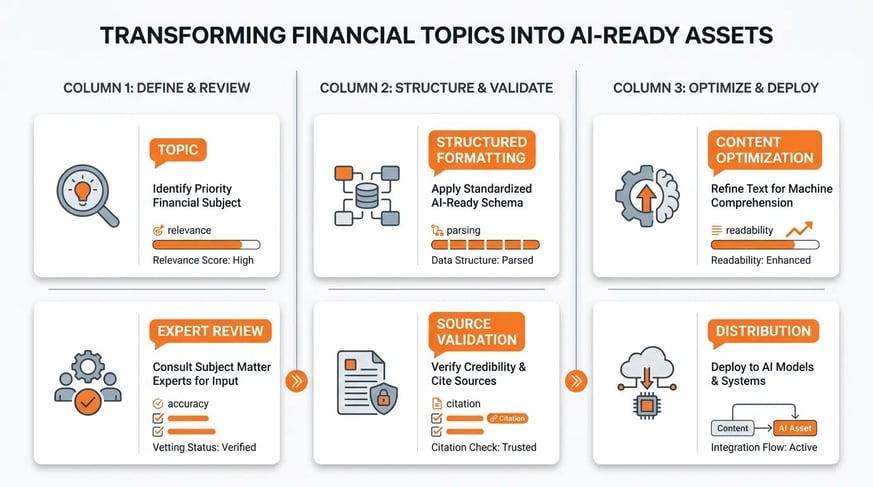
Moving from individual page optimization to strategic implementation, start by identifying the top 40 high-intent and high-trust topics where customers seek guidance; mortgage processes, savings account benefits, business loan requirements, and fraud protection strategies. Create interconnected resource hubs that combine SEO fundamentals with citation-friendly formatting, linking related topics together to build topical authority. For example, a comprehensive mortgage hub might connect rate comparison tools, qualification checklists, and application timelines into a cohesive information ecosystem. This approach both supports traditional search rankings and increases the likelihood that AI systems will reference your institution as a credible source across multiple related queries, driving measurable visibility improvements in both search environments.
Marketing teams at regional banks and credit unions face unique measurement challenges as search behavior shifts toward AI-generated answers, particularly when dealing with regulated financial content that requires both accuracy and compliance. These questions address practical measurement approaches and steps for building visibility across both traditional rankings and AI citations.
Traditional search measurement relies on rankings and clicks, while AI search requires tracking citations and source inclusion. Google Search Console now includes AI feature traffic in Performance reports, showing when your content appears in AI Overviews. Bing Webmaster Tools offers source inclusion tracking that monitors reference frequency and grounding queries. Monitor brand mentions in AI responses and track assisted conversions through multi-touch attribution.
Educational resources that answer specific customer questions perform well for AI citations. Rate comparison guides, loan qualification checklists, fraud prevention steps, fee explanations, and compliance-aware FAQs get referenced frequently. Content with clear data points, expert attribution, and structured formatting using headings and lists makes extraction easier for AI systems. Interconnected resource hubs that connect related financial topics build stronger citation potential than isolated product pages.
Shift reporting focus from clicks alone to brand visibility and assisted conversions. Track reference measurement using AI Performance tools, monitor brand mention increases in AI responses, and measure downstream conversions through CRM integration. Report on engagement quality improvements, such as longer session durations and higher conversion rates from AI-assisted traffic. Include share of voice metrics that capture how often your institution appears as a trusted source compared to competitors.
Combine Google Search Console data with Bing's source inclusion reports for complete visibility tracking. Use brand monitoring tools to capture AI-generated mentions across platforms. Implement multi-touch attribution through your CRM and strategic measurement frameworks to connect AI-assisted discovery with conversions. Set up dashboards that track traditional metrics alongside reference frequency and assisted conversion paths.
Review high-priority educational content quarterly to maintain citation eligibility and accuracy. Financial regulations and rate changes require frequent updates to keep AI systems referencing current information. Conduct monthly checks on your most-cited pages using webmaster tools data. Schedule annual audits of content structure, expert attribution, and information hierarchy to maintain competitive advantage as AI search continues evolving.
Financial institutions don't need to choose between traditional SEO and AI search optimization. The strategic approach combines both into a dual-visibility model that strengthens rankings while increasing citation potential. Google's official guidance confirms that existing SEO fundamentals remain the foundation for AI visibility.
Building on this foundation, the highest-return path forward is a holistic organic growth strategy for AI search and traditional search that aligns technical optimization, content strategy, and funnel refinement. Our proven methodologies show that when every organic investment supports measurable growth across the full customer journey, financial institutions reduce dependency on paid channels while building sustainable competitive advantages. Ready to transform your marketing approach? Explore Performance Marketing Advisors' strategies for accelerating organic performance across both traditional and AI search environments.