
The gap between traffic and retained clients is what separates an SEO problem from a fragmented growth problem. Law firms experiencing frustration with legal focussed SEO agencies due to poor service, high rates, and absent holistic strategies are rarely dealing with a bad vendor alone. They are dealing with an agency model built for yesterday search ecosystem. Performance Marketing Advisors (PMA Group) helps firms move past that model by building data-driven, full-funnel strategies that tie search performance to real business outcomes.
Many law firms feel overcharged by legal focussed SEO agencies not because the rates are arbitrary, but because the deliverables rarely connect to the outcomes that matter. When a retainer keeps producing the same rank reports and generic content month after month, the question about meaningful value becomes hard to ignore.
Rank trackers, templated blog posts, and surface-level reporting are not a growth strategy. They are activity. Firms spending thousands of dollars every month deserve to see measurable movement in qualified enquiries and signed matters, not just a keyword position shifts. When the work looks identical every month, it usually is.
Legal-focused agencies charge for contextual fluency, knowing the difference between personal injury and mass tort, writing content that clears bar association guidelines, and structuring local citations for multi-office practices. That knowledge has genuine value. But what "legal expert SEO" is rarely producing these days is growth in retained clients, conversion rate improvement on practice area pages, content mapped to searcher intent, and CRM feedback loops that reveal which queries produce the most value. According to HubSpot's 2026 State of Marketing, integrated and data-connected strategies are now the baseline expectation for measurable marketing performance, not a premium add-on. Paying a legal-sector premiums for a retainer that stops at rankings means your funding specialization where it costs most and withdrawing it where it matters most.
If an agency cannot show how its work influenced consultation volume, lead quality, or matter value, the reporting gap is the real problem. Rankings are an input, not an outcome. A full-funnel marketing model ties search performance to pipeline data, so the firm can see exactly what is working and why. Without that connection, even a page-one result can be commercially invisible.
Slow response times do more damage than most law firms realize. When an agency takes days to respond to a content approval or technical fix request, that issue continues to inhibit your digital success. Google's crawl budget documentation makes clear that unresolved technical problems consume crawl capacity, meaning fixes that arrive late compound the performance cost. A broken page or outdated local listing is not a minor inconvenience, it is a recurring drag on visibility that only grows the longer it sits unaddressed.
Poor communication also points to a structural problem, not just a service one. According to Search Engine Journal, one of the most common reasons clients leave SEO agencies is unimplemented recommendations and opaque work. These are clear signs that no one owns the growth plan. When a law firm has to chase updates or interpret vague reports, trust erodes and decisions stall. That erosion makes the whole partnership less effective, regardless of where rankings currently are. A strategic advising model with assigned owners, clear priorities, and defined timelines solves this at the operating level, not just the relationship level.
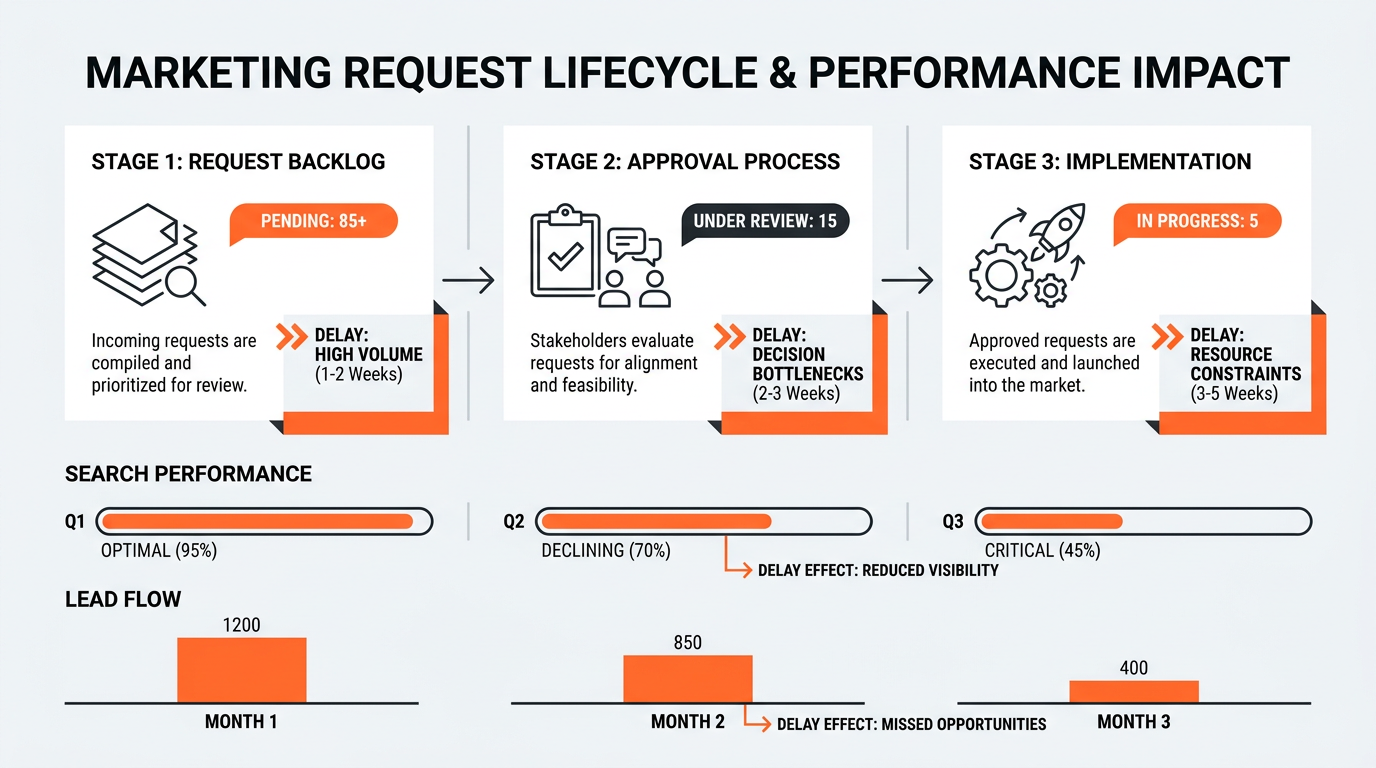
Infographic showing a left-to-right marketing workflow from backlog to approval to implementation, with highlighted handoff delays and small charts illustrating resulting drops in search performance and lead flow. Clean flat icons and bold headings guide the reader through the bottlenecks and impact points.
Most legal SEO retainers stop at rankings. A strategy that actually moves the needle on signed cases has to cover the full path a prospect takes, from their first search to the moment they pick up the phone for a consultation or submit an online form.
Here is what that looks like beyond keyword rankings for law firms:
When these elements are synchronized, a page-one ranking becomes the start of a measurable client journey and not just a data point in a monthly PDF. The gap between search visibility and signed cases is not a Google problem or a content quality problem. It is what happens when the firm's growth functions operate in separate silos with no shared accountability for what happens after a prospect clicks. That is the gap most legal SEO retainers are never designed to close, because closing it requires visibility into conversion, intake, and CRM data that falls outside the retainer's scope.
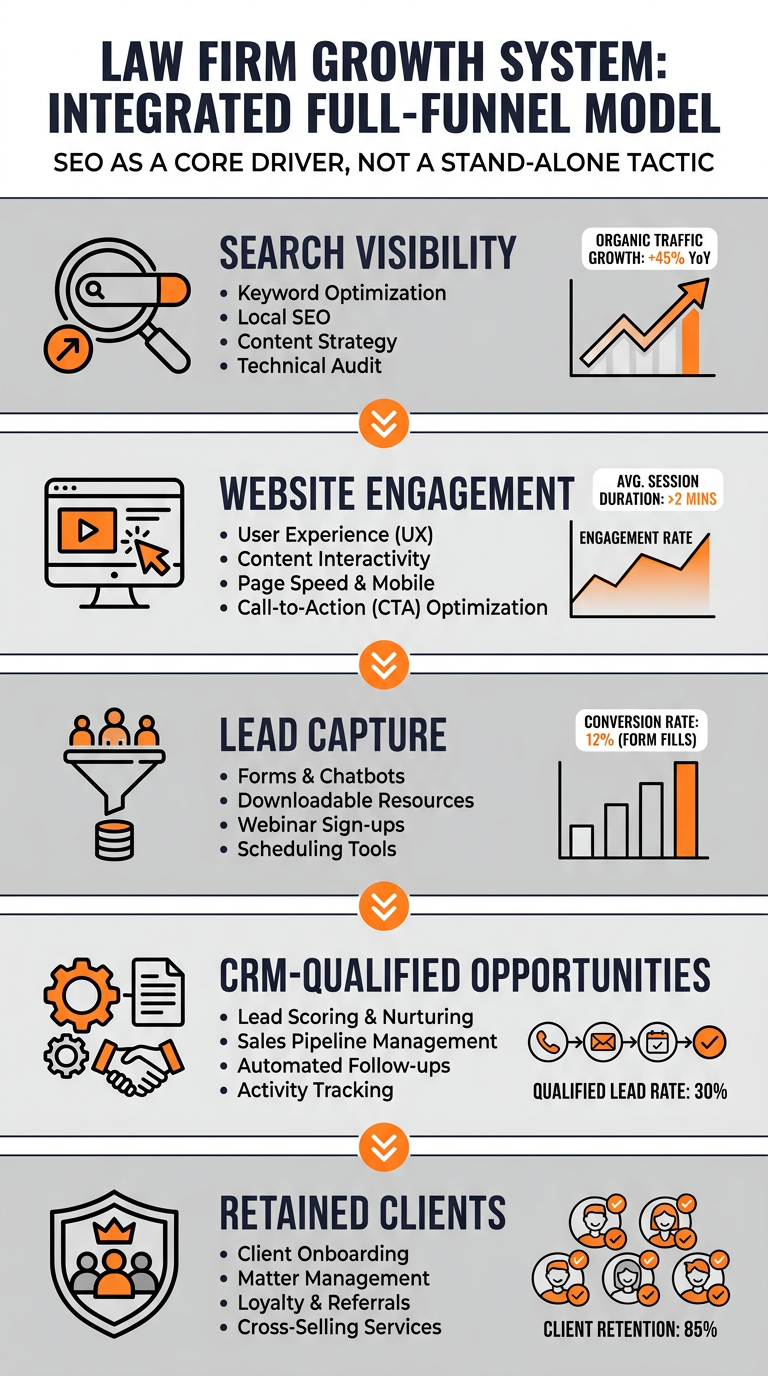
A law firm can rank first for its highest-volume practice area terms and still see flat consultation volume. The reason is structural: most legal SEO work ends at the search result, while the revenue path continues through the landing page, the intake form, the follow-up sequence, and the CRM record that ties a first click to a signed engagement. Why is search visibility alone not enough to grow a law firm's pipeline and signed matters? Because every step after the click is owned by someone else, or by no one. That accountability gap is where qualified prospects quietly fall by the wayside.
Higher rankings do not automatically mean better leads. If a firm ranks for low-intent searches, sends visitors to generic service pages, or has no follow-up process after a form submission traffic gains will rarely translate to revenue. As Search Engine Land notes, not all organic traffic is worth tracking equally. Page-level intent and conversion context matter far more than aggregate volume.
Google's own Search Central guidance has long advised marketers to move past vanity ranking signals toward business-focused metrics like conversions and click-through rates. A credible agency separates SERP movement that matters from movement that does not, measuring which queries, pages, and conversion paths actually influence retained-client growth.
When SEO sits in a silo, disconnected from website conversion data and CRM records, firms lose visibility into what happens after a visitor arrives. As PMA's CRM analytics guide explains, closing that loop reveals which search leads become consultations and which become signed cases. Without it, a firm can keep renewing a retainer that improves rankings but never moves the number that counts.
Most law firm leaders know when something feels off with their SEO agency, but they struggle to articulate exactly what accountability should look like. These questions address the specific signals, KPIs, and reporting habits that separate revenue-focused partners from activity-focused ones.
Ask the agency to show you movement in consultation requests, not just keyword positions. A revenue-focused agency connects search data to lead volume and matter quality. If their reporting stops at rank tracking and organic sessions, they are measuring their own activity, not your strategic outcomes.
Ask three things: Which pages generated qualified consultations last quarter? How did lead quality change as traffic grew? What conversion or CRM work is included in the scope? If the agency cannot answer the first two, the retainer is funding visibility without accountability for what that visibility produces.
Without conversion tracking and CRM data, you cannot see which search leads become signed matters. As Reuters notes, SEO is the most sustainable acquisition channel for law firms, but only when it connects to intake and revenue. A siloed agency strategy will produce ranking gains while your pipeline stays flat.
The KPIs that signal true accountability are cost per qualified consultation, conversion rate by landing page, and matter value by search channel, not aggregate traffic or average position. The National Law Review points to CPA and CLV as the benchmarks that reflect real marketing ROI, and the same logic applies to organic search.
A strategic partner runs structured reviews tied to business priorities, not just monthly rank reports. They use frameworks like OKRs or sprint-based planning to keep work focused on measurable outcomes. If your agency is reactive, hard to reach, and reports on deliverables rather than results, explore what a full-funnel content strategy built around revenue looks like by comparison.
Before renewing another retainer, ask four questions: Which search queries produced consultations last quarter? Which landing pages converted visitors into leads? Where did those leads go in the CRM? How many became signed matters? Most law firms cannot answer all four. This is because their SEO agency is accountable for the first question only. That accountability gap is not a vendor performance issue. It is a structural design flaw in how traditional SEO agencies are built, and it leaves data fragmentation across the firm that no rank report can resolve.
That design flaw is precisely what organizational marketing transformation for law firms addresses. Performance Marketing Advisors builds coordinated, data-driven ecosystems that include comprehensive audits, clear roadmap development, and synchronized channel activation. Our approach draws a traceable line from search query to retained client. If your current agency cannot show you that line, you are not simply overpaying for SEO. You are underfunding growth.