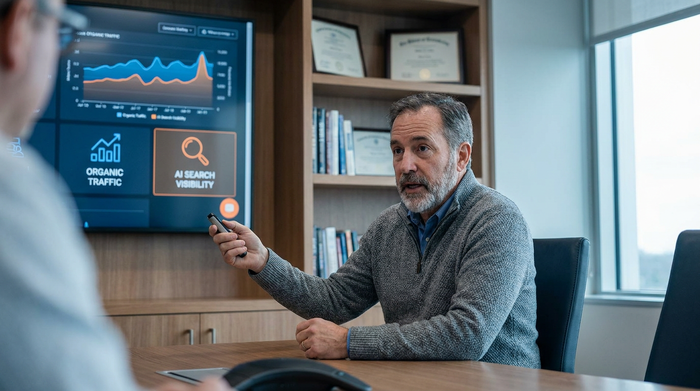
Most personal injury law firm SEO strategy still runs the same playbook it did five years ago: rank for a handful of practice-area terms, drive traffic to isolated service pages, and report on position. That approach did not just fail to anticipate AI-driven discovery. It actively deprioritized the exact signals AI now rewards, such as verifiable credentials, structured data, and attributed expertise, because none of those things moved a needle calibrated only to rankings.
Google now surfaces AI Overviews above organic results, pulling synthesized answers from sources it judges authoritative and well-structured. A firm can hold a page-one ranking and still be invisible if the AI layer does not find enough credible, consistent evidence to include it in a summary.
Old playbooks optimized for crawlability and keyword density. They underinvested in what Google now explicitly rewards: original, expert-led content with clear authorship and verifiable credentials. Google's AI optimization guidance ties generative feature inclusion directly to those signals, not to rankings alone. A firm that is easy to rank is not automatically easy to trust or cite.
The right frame for a personal injury law firm SEO strategy in 2026 is not "how do we rank" but "how do we build verifiable authority that compounds across search, local packs, and AI answer engines." That distinction is not semantic, it changes what you actually build: attorney credentialing surfaced in structured data instead of buried in a headshot-and-bio block; outcome evidence organized by case type instead of scattered across blog archives; content architecture that signals topical depth rather than isolated pages chasing individual queries. Google's guidance on AI-generated content reinforces that people-first, expertise-driven content is what its systems are designed to surface. Disconnected on-page tasks do not add up to that, but a coordinated authority system does.
Most local SEO work for personal injury firms still chases broad city-level visibility: rank in the map pack, get impressions, hope the phone rings. That logic made more sense when search behavior was simpler. Today, someone who just had a car accident is not searching "personal injury lawyer Chicago" in the same casual way someone browses for restaurants. They are actively looking for a firm they can trust, often from a mobile device, often within hours of an incident. Winning that moment requires local signals aligned around case-type intent, not raw geographic coverage. For firms trying to understand how a personal injury law firm can improve local SEO to win high-intent cases in competitive markets, the answer starts with specificity, not scale.
areaServed, geo, contactPoint, and aggregateRating help search engines and AI answer engines interpret your firm's service footprint accurately. Firms that skip this step leave discoverable authority on the table, especially as AI-driven results increasingly rely on structured, verifiable data rather than prose alone.The measure of success here is not more impressions from broad local queries. It is more qualified discovery from prospects who are close to making a decision. As PMA Group's research on AI-driven customer acquisition shows, the firms that earn visibility in AI-influenced results are the ones that have built trust signals into the fabric of their digital presence, not the ones that simply occupied the most search real estate.
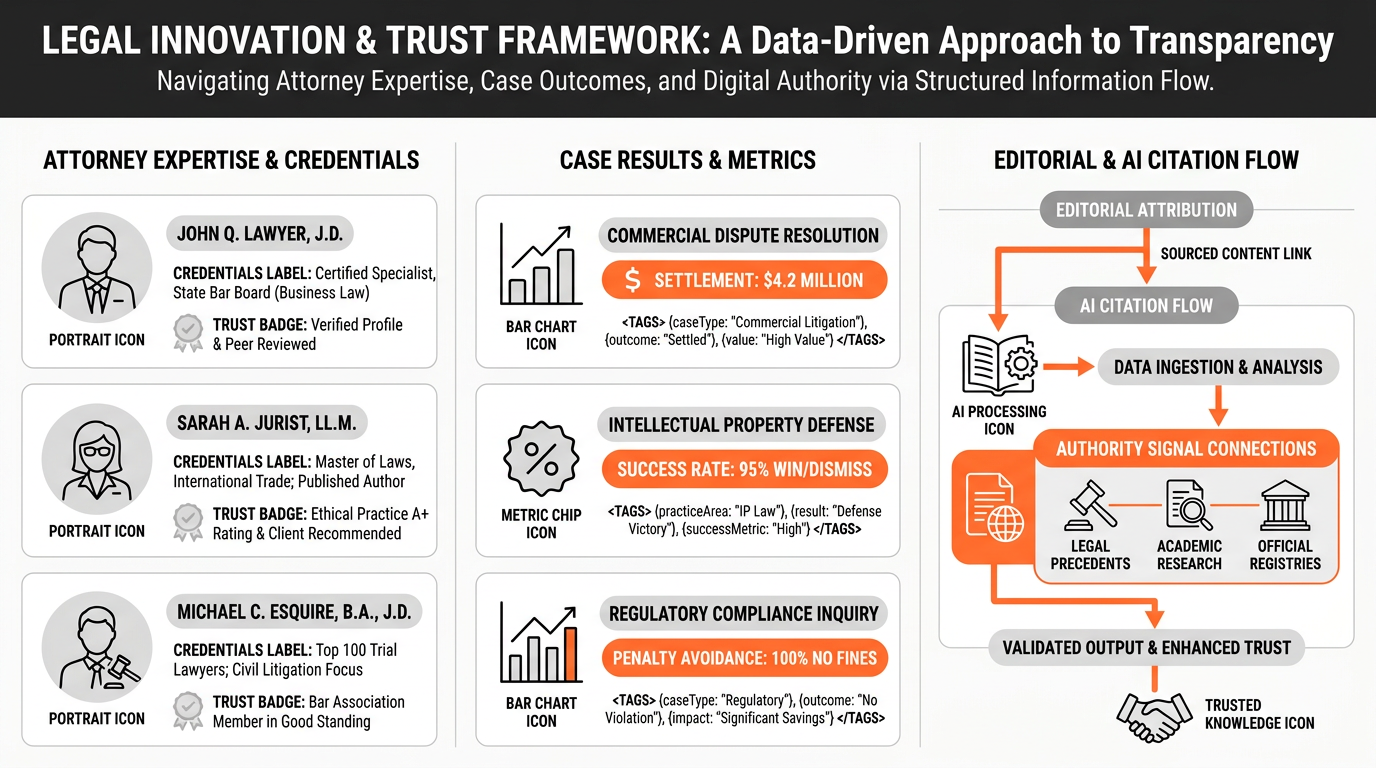
When AI answer engines evaluate whether to cite a personal injury firm, they look for authority signals that go well beyond rankings. The structure of bios, case pages, and legal content tells search systems whether your attorneys are genuinely qualified to speak on a topic, or just optimized to appear that way.
An attorney bio that lists a name, bar number, and headshot is not enough in 2026. Google's helpful content guidelines ask whether content was produced by someone with demonstrable expertise. That means bios should surface practice focus, specific case types handled, bar admissions by jurisdiction, speaking engagements, and publications. Each element gives both users and machines a concrete reason to trust the source behind the content.
Case pages carry some of the strongest authority signals on a personal injury site, but only when structured clearly. Outcomes should include jurisdiction context, legal process detail, and editorial attribution so AI systems can interpret who handled the matter and how. Attorney schema markup using properties like hasCredential, areaServed, and knowsAbout makes that information machine-readable. Answer engines can then process and surface your results with confidence.
When bios attribute expertise by practice area but FAQs go unsigned, or case pages omit the attorney of record, AI systems encounter a verification gap: they cannot confirm who knows what they claim to know. That ambiguity is an immediate disqualifier. Consistent editorial ownership, named attorneys on substantive content, credentials visible where content is published, and schema that connects each author to the firm and practice area, gives AI systems the verifiable chain they need to cite with confidence. Packaging expertise consistently is not a formatting preference. It is the difference between a firm that earns AI citations and one that ranks but never gets referenced.
Most personal injury firms treat content as a blog calendar, publishing posts sporadically with little connection between them. That approach produces isolated pages rather than a system, and isolated pages cannot do what a connected ecosystem does: guide a prospect from their first question all the way to a consultation request, without a paid ad carrying them at every step. Original, in-depth, expert-authored resources with clear editorial ownership earn durable organic visibility and compound discoverability over time rather than producing one-off traffic spikes. PMA's pillar-and-cluster framework provides a practical structure for pulling this together: one authoritative pillar page per practice area, surrounded by tightly linked cluster content that reinforces topical depth and captures demand at every stage.
Here is what that ecosystem looks like in practice for a personal injury firm:
Firms that build this kind of connected structure, rather than publishing content in disconnected bursts, can cover early research, mid-funnel comparison, and ready-to-contact demand from organic channels. That reach reduces the gap that paid traffic currently fills, which is exactly the shift that sustainable organic growth strategy is designed to produce.
Marketing leaders evaluating organic strategy for a personal injury firm often hit the same walls: the tactics look familiar, but the results do not reflect how prospects actually discover and choose legal representation today. The questions below address where the real gaps tend to be and what a stronger approach looks like in practice.
Each bio should make expertise verifiable, not just stated. List bar admissions, practice focus, speaking engagements, and publications. Case pages should include jurisdiction context, outcome detail, and clear editorial ownership. Authorship clarity and content depth separate credible legal pages from thin, templated ones. And those are the signals AI systems read when deciding which sources to surface.
AI systems favor sources they can verify and summarize with confidence. That means structured data using LegalService schema, consistent attorney attribution across bios and legal guides, and content that answers specific legal questions in clear, complete language. Google's own reporting on AI Overviews shows that included source links see higher click-through rates, making structured authority a direct pipeline driver, not just a ranking factor.
Firms that align their Google Business Profile, location pages, and review strategy around specific case types, like auto accidents, truck accidents, medical malpractice, and premises liability, capture higher-intent prospects than broad city-level visibility produces. Service-area specificity and consistent attorney presence across local content tell both users and search systems that the firm has genuine relevance in that market.
When service pages, legal explainers, FAQs, and case pages are connected and internally linked, one piece of content supports multiple discovery moments. A prospect researching a slip-and-fall claim, comparing attorneys, or ready to call can all find an entry point organically. PMA's AI and traditional search visibility guide outlines how this compounding structure reduces paid dependency over time.
Yes, AI-driven answer engines now select sources based on verifiable authority and content structure, not rankings alone. Three years ago, ranking for a practice-area keyword was a reasonable proxy for visibility. Today, firms still running blue-link-only playbooks are optimizing for one channel in a multi-channel discovery environment; technical SEO mechanics remain necessary but are no longer sufficient on their own.
The personal injury firms that will lead in 2026 are not the ones adding more SEO tasks to an already fragmented checklist. They are the ones that recognized a specific shift: ranking for practice-area keywords is now table stakes, not a strategy. The firms getting surfaced, cited, and trusted by AI-driven answer engines built verifiable authority into the structure of their sites. Attorney credentialing in schema, case evidence organized by outcome and jurisdiction, and full-funnel content ecosystems should be working together rather than compete for the same queries. That is what organic business growth strategies look like when they are built to compound over time.
Demonstrable expertise, consistent authority signals, and structured content that AI systems can verify is not optional in 2026. Firms still running blue-link-only playbooks are not just leaving AI visibility on the table, they are ceding qualified cases to competitors who build for both. Performance Marketing Advisors partners with firms ready to close that gap. We work collaboratively with our clients to build organic and AI visibility strategies that compound discoverability and drive qualified leads, ultimately reducing their reliance on paid media.